Caine duty
The Caine MutinyCaine duty is the novel’s name for the unglamorous service that keeps a war effort functioning: long watches, routine paperwork, escort work, and occasional direct contact with mines. At the decommissioning of the fictional USS Caine, Willie Keith gives this labor its clearest meaning. The ship has no spectacular record, yet its crew has spent years doing work the fleet required. His account makes ordinary service—not distinction or recognition—the measure of the crew’s contribution.
Definition and Historical Frame
The novel sets the ship’s work against a widening gap between the large-scale story of the war and the daily experience of those serving at sea. By the beginning of 1944, major turning points had passed and the Allies’ prospects appeared strong. Willie Keith, however, sees the war from the Caine’s wheelhouse: the immediate prospect is a dangerous Pacific campaign, not a historian’s reassuring overview. When a vast armada sails from Hawaii toward Kwajalein, its orderly formation embodies the scale of the operations in which an individual minesweeper must find its place.
That setting is explicitly fictionalized. The book’s introductory note says that its people and events aboard the Caine are imaginary, that no ship named USS Caine existed, and that actual operational times, places, ship names, missions, and communications procedures have been altered. Caine duty therefore describes the novel’s representation of wartime service, not a documented history of a real vessel. This distinction matters: the ship’s modest record is part of the book’s argument about the value of routine work, not a claim that its invented history is an archival account.
The Work Behind the War
The Caine’s service is made up largely of tasks that do not resemble decisive battle. Its communications work alone means handling a stream of fleet messages whose decoding and distribution weigh heavily on destroyer communicators. At Funafuti Atoll, Willie finds relief in using a destroyer tender’s communications office, where messages are decoded and mimeographed. The episode makes visible a support system that can spare one overburdened ship’s communicator days of work, even as it hints at how much paper labor sustains naval operations.
Shipboard routine is equally consuming. Willie’s working life cycles through bridge watches, coding, correcting publications, meals, and sleep in the cramped clipping shack. In rough weather, the ship’s motion and the repeating demands of duty narrow his world to the bridge, the work, and the next interrupted rest. Later, across months of escort service, the same pattern expands into logs, monthly reports, audits, watch rotations, and repeated journeys. Time seems shapeless because the work recurs: the duties matter to the ship’s continued operation precisely though no single day appears decisive.
The routine also unfolds within the Caine’s imperfect material conditions and tense shipboard order. Willie first finds a sleeping space in a metal clipping shack that measures only a few feet across and is about 105 degrees inside. Under Philip Queeg’s new rules, enforcement proves uneven: after a cigarette butt is found in a scupper, the crew loses liberty, but the new order is observed most closely within the captain’s immediate reach. Outside that limited sphere, established habits persist. The ship’s formal regulations and the crew’s practical routines coexist uneasily, shaping the conditions under which ordinary duties are performed.
Escort Service and the Rare Mine
The Caine’s prolonged escort work places it within the movement of larger forces. Attached to the Seventh Fleet, it is sent among South Pacific destinations as amphibious forces are shuttled through the region. Its assignments include escorting slow landing craft and repeated passages between bases. The vessel’s age and lack of a permanent command leave it available for the needs of whichever naval authority it enters, while its own work remains a succession of necessary but repetitive journeys.
The ship’s eventual mine-sweeping achievement is striking precisely because it is so rare. Seventeen days before the war ends, the Caine finally sweeps a mine in the China Sea. A mine rises in its wake; the crew marks and reports it, and a nearby sub chaser destroys it. The event briefly puts the vessel’s intended role at the center of the action, but it does not overturn the larger pattern of its service. Keith later counts six mines swept in the entire war, set beside several hundred thousand miles of mostly dull escort duty.
After the pumps are repaired, the Caine still cannot join the minesweepers preparing to clear Tokyo Harbor for the victorious fleet. The operations officer judges it too unreliable for the journey and the typhoon season, especially at its limited speed. Its exclusion is a practical consequence of its worn condition, not a dramatic rejection of its crew. The missed assignment reinforces the contrast between the fleet’s advance toward victory and the humble ship’s constrained capacity to take part.
Meaning and Ending
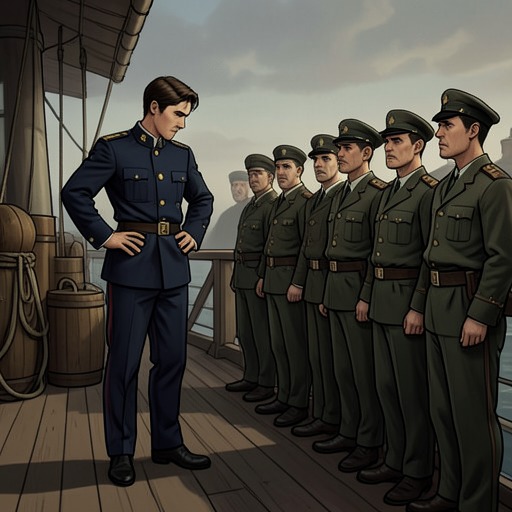
At decommissioning, Keith names the Caine an obsolete, damaged ship without a unit citation or spectacular achievement. He nevertheless tells the crew that their hours aboard it were part of the work required to keep the country going. The speech changes the scale by which the ship’s record is judged: a mission need not be celebrated to contribute to victory, and routine labor need not be exceptional to matter. The Caine’s work, in his account, belongs to the same collective effort as the more visible operations that fixed the dates and places of victory.
The ship’s flag is lowered, and Keith keeps the remnant of its commission pennant, asking for the jack as well. The gesture gives the ending a material focus: the vessel’s active service is over, but its crew’s shared history remains something to carry away. Keith’s final formulation, “Caine duty is the kind of duty that counts,” condenses the concept. The phrase honors not a record of spectacular success but the necessary, repetitive labor that made the fleet’s larger achievements possible.